 | Paul's Tennis Page For the Cary, NC Area |
Volleys and Overheads
Taking the ball out of the air
Volleys -- Technique
You have to have good volley technique to play doubles.
Here are several videos that each address different aspects of hitting a volley.
Yes, there are a lot of them. The volley is that important in doubles.
- Ready Position:
- Rotate your Hips:
- Five Volley Types:
- High Volleys:
- Gigi Fernandez on the Mid-Court Volley:
- That Easy Slow Volley:
Volleys -- Angles and Targets
Playing serve and volley singles at the 3.0 level is not commonly seen.
So 3.0 singles players can be quite effective staying at the baseline and just being more consistent in long rallies than their opponents.
The goal of the baseline player in doubles is very much the same, except that it is complicated by needing to keep the ball away from the net player.
So when your chance comes to hit a volley, you want to find an open court gap between the Villains or hit it to the feet of their net player.
Often volleys in doubles are reflexive and do go straight back to the deep player.
But when you do have that extra second to prepare, you should direct your
volley at the feet of the net player, or to Side Service T's to end the point.
This is something that you need to practice with a friend feeding you from a bucket of balls or with a ball machine. Why? Because if you are having a partner hit volleys to you
with a handful of balls, you are going to hit them back to them so you can keep a volley rally going.
This is not what you want to do in a match!
So practice the way you want to hit the ball in matches.
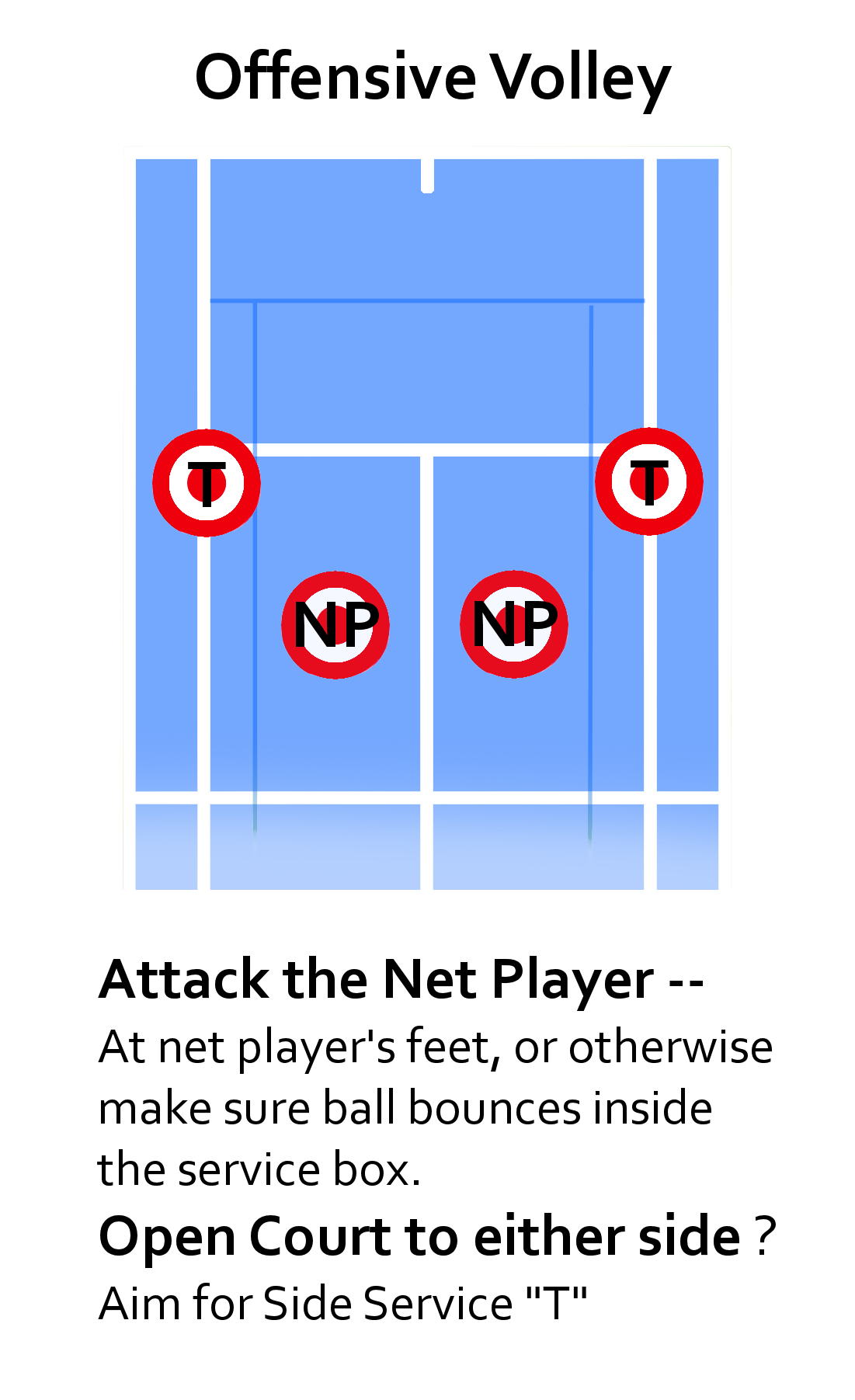
Offensive Volleys are hit from inside the service box and are above the net.
They are your opportunity to end the point and should be sharply angled to the sides of the service box, or the feet of the net player.
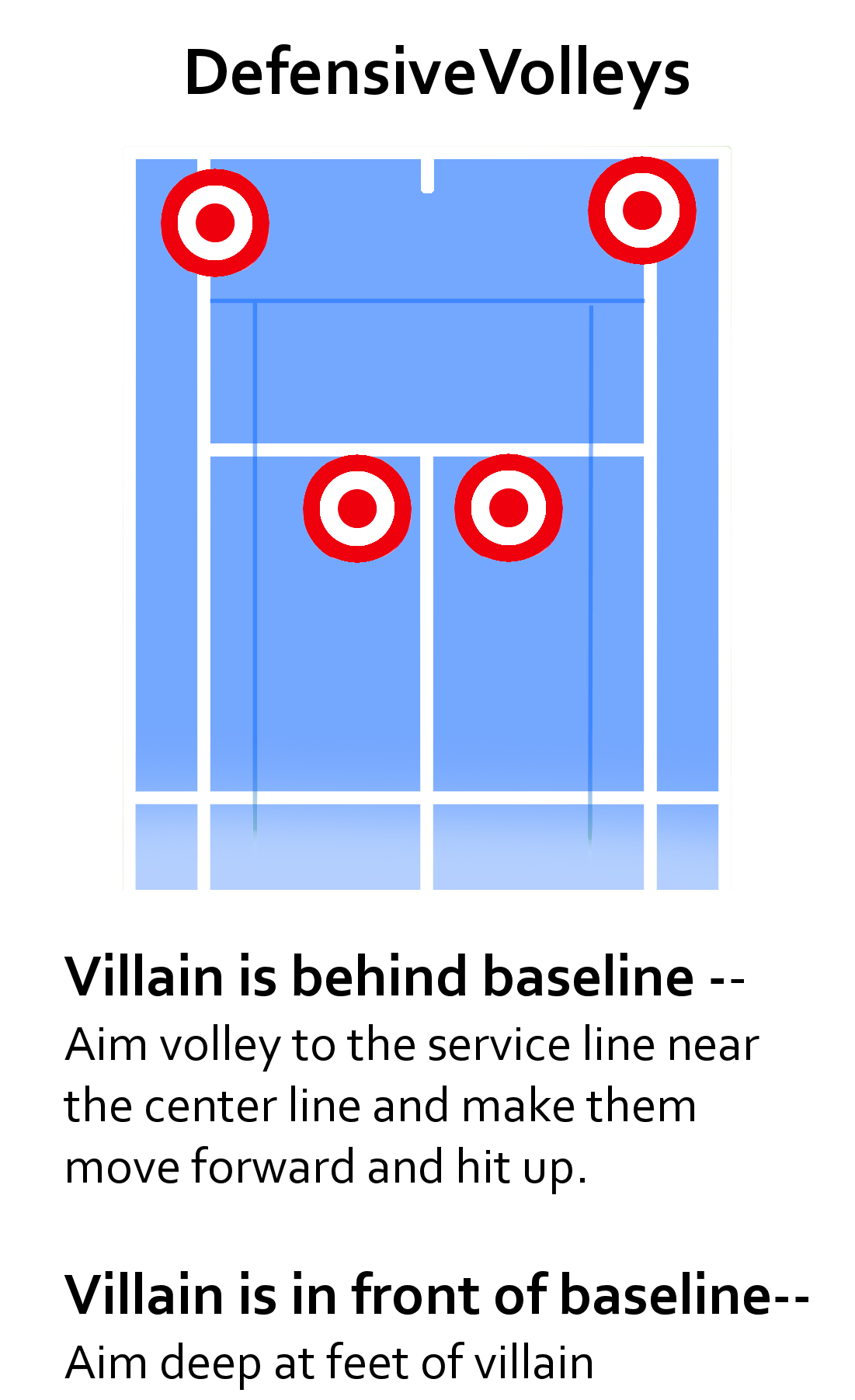
Defensive Volleys are hit from behind the service line or are below the net. You goal in this case, is not win the point but to make the Villains hit from deep
and allow you to move forward to have a chance at a higher volley on the next ball. The worst thing you can do here is hit a volley that lands around the junior court baseline
and gives the Villain a nice ball for a big ground stroke.
And here again is that example of hitting to those Side Service "T"s.
Reminder: The best way to get that extra second so you can volley to the sides, is to split step as the ball is hit.
Then you are ready to move left or right to get to the ball.
But while we are on the subject, split stepping is not just for net players:
Overheads
You have to have good volley technique to play doubles. Here are several videos that each address different aspects of hitting a volley. Yes, there are a lot of them. The volley is that important in doubles.
- Ready Position:
- Rotate your Hips:
- Five Volley Types:
- High Volleys:
- Gigi Fernandez on the Mid-Court Volley:
- That Easy Slow Volley:
Playing serve and volley singles at the 3.0 level is not commonly seen. So 3.0 singles players can be quite effective staying at the baseline and just being more consistent in long rallies than their opponents.
The goal of the baseline player in doubles is very much the same, except that it is complicated by needing to keep the ball away from the net player.
So when your chance comes to hit a volley, you want to find an open court gap between the Villains or hit it to the feet of their net player.
Often volleys in doubles are reflexive and do go straight back to the deep player. But when you do have that extra second to prepare, you should direct your volley at the feet of the net player, or to Side Service T's to end the point.
This is something that you need to practice with a friend feeding you from a bucket of balls or with a ball machine. Why? Because if you are having a partner hit volleys to you with a handful of balls, you are going to hit them back to them so you can keep a volley rally going. This is not what you want to do in a match! So practice the way you want to hit the ball in matches.
Offensive Volleys are hit from inside the service box and are above the net. They are your opportunity to end the point and should be sharply angled to the sides of the service box, or the feet of the net player.
Defensive Volleys are hit from behind the service line or are below the net. You goal in this case, is not win the point but to make the Villains hit from deep and allow you to move forward to have a chance at a higher volley on the next ball. The worst thing you can do here is hit a volley that lands around the junior court baseline and gives the Villain a nice ball for a big ground stroke.
And here again is that example of hitting to those Side Service "T"s.
Reminder: The best way to get that extra second so you can volley to the sides, is to split step as the ball is hit. Then you are ready to move left or right to get to the ball.
But while we are on the subject, split stepping is not just for net players:
With the goal to keep the ball low and making your opponents hit up over the net, you need to be comfortable taking balls out of the air without letting them bounce. Doubles players should practice hitting overheads or swinging volleys a lot. For very high balls, letting them bounce may be the best choice, but letting it bounce has three side effects.
- It moves you far back in the court and gives your opponents extra time.
- It reduces the angles that you can hit and makes it easier for your opponents to return.
- A lot of spin on the ball can make it bounce in any direction.
Overhead --Technique
|
|
|
| | |
 |
Copyright (c) 2000-2025, Sea Scripts |